

Zayd Ayers Dohrn by Carlos Murillo
A raucous musical rooted in Chicago’s history of activism and Rage Against the Machine.
October 17, 2025
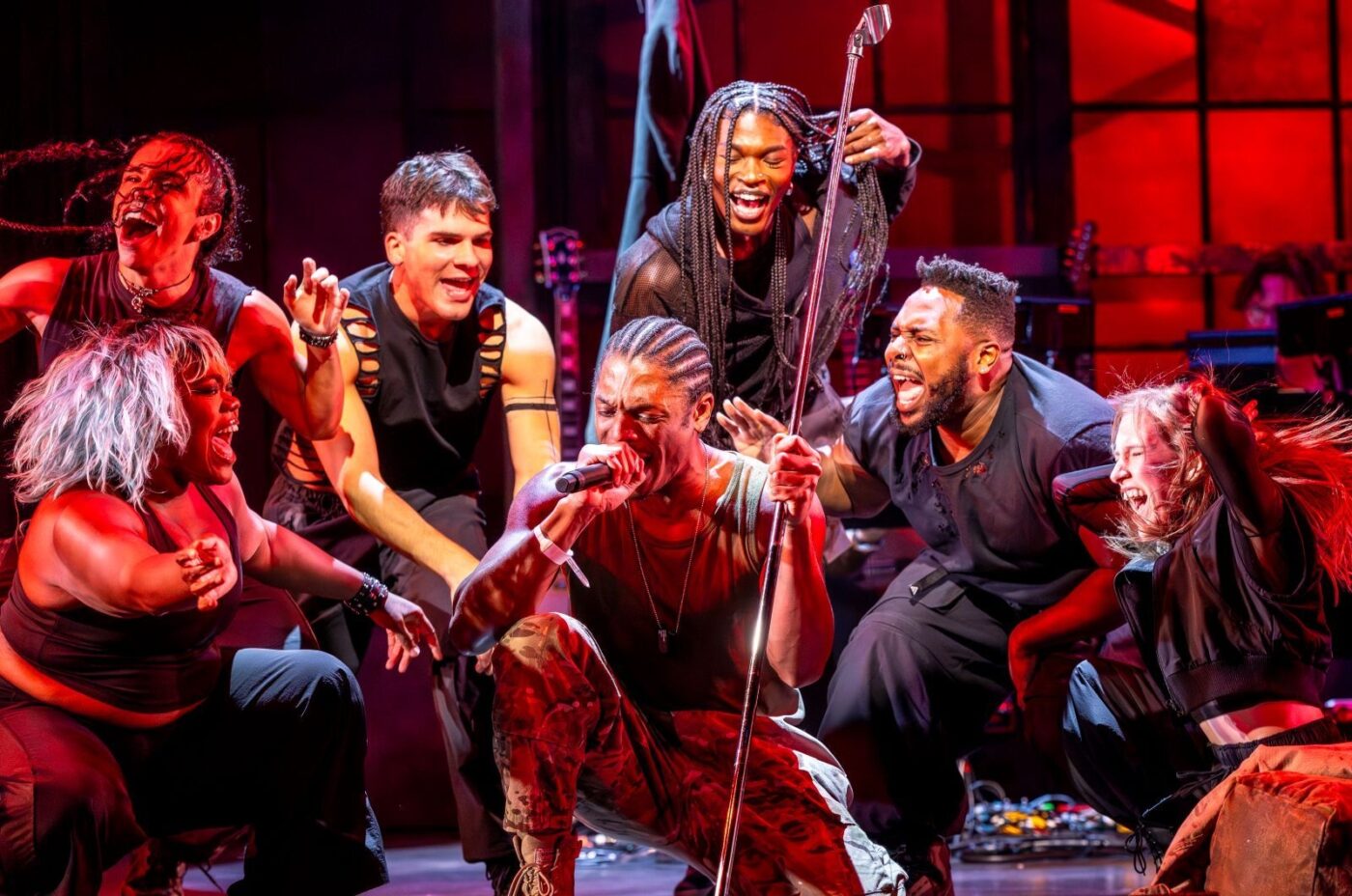
Performance still from Zayd Ayers Dohrn, Revolution(s), 2025. Kendal Marie Wilson, AJ Paramo, Christopher Kelley, Aaron James McKenzie, Jarais Musgrove, Eric A. Lewis, and Haley Gustafson pictured. Photo by Brett Beiner. Courtesy of The Goodman, Chicago.
In celebration of the centennial season of Chicago’s Goodman Theatre,
they have opened the highly anticipated musical Revolution(s) (2025),
which combines punk, hip-hop, and heavy metal. A collaboration between
award-winning playwright and Northwestern University professor Zayd
Ayers Dohrn and Rock and Roll Hall of Fame musician Tom Morello of
Rage Against the Machine, the musical examines the Second City’s legacy
of racism, police violence, political activism, and the art-maker’s role in
the resistance. The production comes at a tense moment in Chicago’s history,
with the National Guard occupation and daily reports of Immigration and
Customs Enforcement (ICE) raids on the city’s streets. Dohrn, who wrote
the musical’s book, discussed with me the origins of Revolution(s), the
personal and professional impact of the legacy of activism in Chicago,
and the reaction he expects from theater audiences unaccustomed to the
high-decibel musical stylings of his collaborator Tom Morello.
Carlos Murillo: Tell me about the genesis of Revolution(s) and the road it followed to its world-premiere production at the Goodman Theatre.
Zayd Ayers Dohrn: The project started during the first Trump administration. I was thinking about ways to respond creatively to what was going on in the world. I found myself listening to albums by Rage Against the Machine. The music matched the vibe I was feeling at the time. I reached out to Tom Morello and proposed this crazy idea: What if I wrote a story that incorporated some of his songs, and we put it on as a kind of underground concert/narrative/protest? I told him he didn’t have to give me any rights. I would write the script on spec. If he didn’t like it, no harm done. He was super generous about the idea, but then I got busy with other projects and didn’t really get to work until the pandemic. In 2020, in the wake of George Floyd’s murder, amidst all the protests and authoritarian power grabs, I sat down and wrote the script in a couple months. I sent it to Tom, he liked it, and we started going back and forth about different songs, new music, et cetera. I’d been developing work at the Goodman for a while, and they came on board and programmed it for their New Stages Festival last year.

Performance still from Zayd Ayers Dohrn, Revolution(s), 2025. Kendal Marie Wilson, AJ Paramo, Christopher Kelley, Aaron James McKenzie, Jarais Musgrove, Billy Rude, and Haley Gustafson pictured. Photo by Brett Beiner. Courtesy of The Goodman, Chicago.
CM: Is this your first musical? How does this piece fit in with your large body of work?
ZAD: It is my first musical. That part of the process is completely new to me. I couldn’t imagine working on it without musical geniuses like Tom and Jason Michael Webb, the music supervisor. Thematically, I do think it fits into my larger body of work. It’s about people struggling to change the world, the complicated relationship between art and activism, family dysfunction, and the generational burden of revolutionary change.
CM: I’m curious to know more about the collaboration. As a theater-maker working with a rock musician—artists who have two very different practices—how have you adapted to each other’s language?
ZAD: You’re right, theater and rock have very different practices, but one of the things that drew me to Tom’s music is its broad, unexpected emotional and narrative range. Of course, our show has some of the edge that comes from the punk/metal hardcore of Rage Against the Machine and Audioslave. That said, Tom also has a folk solo act called The Nightwatchman that has a feel along the lines of Bob Dylan, Bruce Springsteen, and Woody Guthrie. Additionally, he has hip-hop collaborations with Boots Riley, Killer Mike, and Big Boi, all of whom have lyrics in our show. Tom has written some beautiful love songs and ballads, too. More than anything, his music has something to say—often in very narrative, dramatic terms, so I found it pretty easy to work in his language. As for Tom, he apparently thought very seriously in high school about becoming an actor before he became a rock star, so theater is in his blood.

Performance still from Zayd Ayers Dohrn, Revolution(s), 2025. Alysia Velez and Aaron James McKenzie pictured. Photo by Brett Beiner. Courtesy of The Goodman, Chicago.
CM: I’m fascinated by the simultaneity of past and present in Revolution(s). The piece hopscotches in time between the story of Hampton Weems, a young aspiring musician and soldier who gets caught up in the resistance after returning to Chicago from Afghanistan, and the courtship and radicalization of his parents a generation earlier. Talk about your impulse to juxtapose these narratives.
ZAD: I’ve always been interested in history’s echoes, and how each of us is both forging a new future and reckoning with the burdens of the past. Marx says that “The tradition of all dead generations weighs like a nightmare on the brains of the living,” and I’m fascinated by the quality of that weight; how, basically, we’re all haunted by the past. We can’t figure out how to move forward without hearing the echoes of history. That’s true in politics and in art.
CM: A big part of your own history is having been raised by noteworthy radicals and Weather Underground founders Bill Ayers and Bernadine Dohrn. How has their history shaped this and your other work?
ZAD: I don’t think about it much when I’m writing, but being around people who have such radical commitments and have dedicated their lives to making revolutionary change has shaped all my work. I’m not an activist in the way they are, but my creative work is of course shaped by that influence.
CM: Chicago is central to Revolution(s); the city has a long and storied history of fostering resistance and social justice movements. How has the city shaped you as a writer and this work?
ZAD: Chicago is essential to Revolution(s). Both Tom and I grew up here, and our artistic and political sensibilities are shaped by the Chicagoland area. The play is very much about the legacy of social justice in this city in particular, all the way from the Haymarket riots to the Days of Rage, to Fred Hampton and the Black Panthers, and to today’s radical movements.
CM: Revolution(s)’s characters live at the intersection of resistance, romantic love, and art-making. What drew you to center those three preoccupations?
ZAD: That intersection is what my work is always about. How can art make meaningful change? How does political resistance impact our personal relationships? What’s love got to do with it?

Performance still from Zayd Ayers Dohrn, Revolution(s), 2025. Jackie Burns and Al’Jaleel McGhee pictured. Photo by Brett Beiner. Courtesy of The Goodman, Chicago.
CM: Theater projects often take so long to gestate that the sociopolitical climate transforms between a project’s conception and when it comes to fruition. How does Revolution(s) speak to the current climate? Have you adapted the work to address what’s happening now?
ZAD: That’s the craziest thing. I wrote the play in 2020. There were riots in Portland and Seattle. Thousands of protests across the country. The National Guard was being deployed. Trump was using soldiers to clear protestors from Lafayette Park for a Christian Nationalist photo opportunity in DC. It seemed like peak revolutionary-versus-authoritarian conflict. I was very much writing into and for that moment. But, as you say, plays take years to get produced, if they’re ever produced at all, especially a big, ambitious show on this scale. I figured by the time it got on its feet, this musical might feel like a period piece. However, part of the message of the play is that history has a way of coming back around again. Here we are, five years later, and the play went up right as the President of the United States threatened to go to war with the city of Chicago. It’s surreal. Feels like it’s time for a revolution.
CM: The Goodman is a storied Chicago institution with a long history of putting on many great and sometimes groundbreaking works. That said, a maximum volume punk, hip-hop, and metal-hybrid musical is not something you often see on its stages. What are your expectations of how the audience will receive the work? Are there conversations around bridging their audience with the audience that are, say, fans of Rage Against the Machine?
ZAD: I love that question. I was frankly surprised the Goodman decided to do this show. It is very different from anything they’ve done before. Kind of an anti-musical. It’s very loud. But the Goodman’s new artistic director, Susan Booth, is interested in taking big risks and bringing new audiences into the Goodman. We have a bunch of performances that are going to be free for Chicago Public School students, and we’re hoping to bring in an audience that’s younger, more diverse, and may not be your typical League of Resident Theatres theatergoer. Our brilliant director, Steve Broadnax, talks about the show as a “concert narrative”; what you’re going to get is a loud punk, metal, hip-hop, rock show that happens to have a story threaded through the noise. Hopefully, the show will appeal to folks who may have never been to a play and will feel a bit like they’re at a rock concert or a warehouse rave.
CM: What are your takeaways from this experience that you think will inform your work on future projects?
ZAD: I never thought I’d say this, but I’d love to write another musical.
Revolution(s) plays at the Goodman Theatre in Chicago through November 16.
Support BOMB’s mission to deliver the artist’s voice.